About The Work: Poetic Visual Stories of Our Connections to Nature
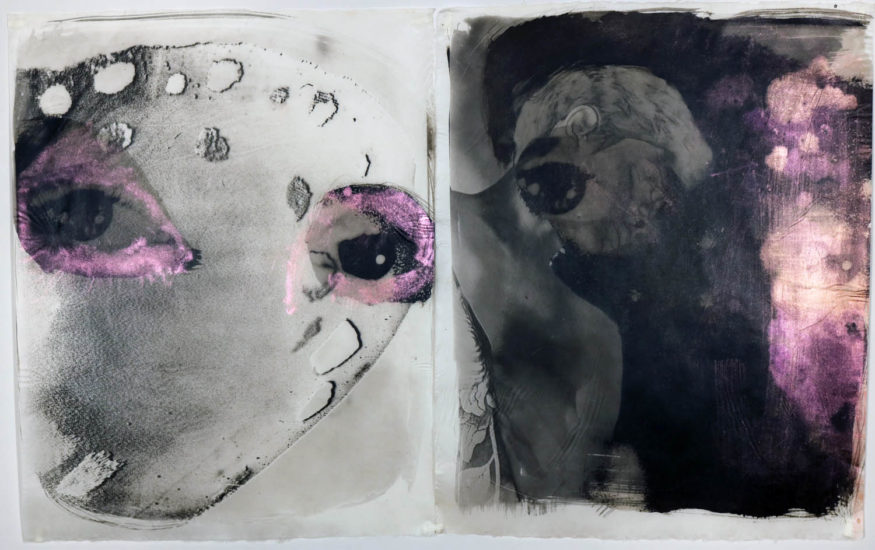
My eyes are always searching and yet, the lifting, fluttering flight of the butterfly across time and memory eludes me.
We are not separate from nature–we are made of it. In an era of accelerating climate crisis, ocean warming, species extinction, and the continuing oppression of women and earth in tandem, I make work that refuses that separation. My practice is rooted in ecofeminist philosophy: the understanding that the domination of the natural world and the domination of women arise from the same cultural logic, and that both demand the same resistance– a return to interdependence, to kinship, to the radical acknowledgment that human bodies are ecosystems embedded in larger ecosystems.
Working in four interlocking bodies of work–Ecofeminism, Fauna, Flora, and Sea–I combine photography, camera-less darkroom processes, and hand-painted surfaces to create images where the human body merges with the animal, the botanical, and the oceanic. The boundary between figure and environment dissolves. My subjects do not stand before nature: they are continuous with it.
Tattoos As Ecological Inscription
Tattoos are central to my practice as a philosophical proposition. Tattooed human skin–already a surface where culture writes itself onto a body–becomes in my work a site of merger: flesh intertwining with serpents, roots, dragonfly wings, botanical forms, the sea. The body is revealed not as a bounded self, but as a permeable membrane continuous with the larger organism of the world. As light records a visual memory on a photographic surface that fades and transforms over time, tattoos mark the changing of time on evolving flesh. Both are records of passage; both insist on the body’s entanglement with forces larger than itself.
Process as Philosophy
My materials are chosen with intention. I print with the palladium process–a 19th century technique that produces tonal distinctions of extreme subtlety, allowing even the deepest darks to retain and reflect light–onto Japanese gampi paper, a handmade sheet drawn from the fibers of a wild plant. Its texture is silken, almost skin-like, recalling the membranes we share with all animate life. Once the palladium solution is painted and exposed to sunlight, the print cannot be revised; the paper substrate is permanently altered. Multiple printings layer tone on tone into the gampi’s fibers, much as a tattooist’s ink penetrates skin–irreversible, embodied, cumulative.
I work in a traditional analogue darkroom, making camera-less negatives by placing flower, leaves, and seaweed directly in the enlarger and allowing them to draw their own portraits–a practice that traces back to the pre-camera experiments of William Henry Fox Talbot and Anna Atkins in the 1830s. For my assemblages of printing these negatives with palladium, I add pearlescent watercolor and hand-drawn marks. I assemble multiple processes and materials into each final work. The result is a hybrid object: part photographic record, part painting, part material investigation of what it means to be alive in a world of organisms.
Lineage and Context
My work is situated within the tradition of ecofeminist art that emerged in the 1970s alongside the environmental and feminist movements–the tradition of Agnes Denes, Ana Mendieta, and the artists brought together by EcoArtSpace, with whom I have exhibited. Like those predecessors, I am committed to art that does not merely represent ecological crisis but enacts, at the level of material and process, a different relationship to the living world. Closer to nature in their daily lives, human cultures of the past held an intuitive understanding of their unity with all of earth’s organisms. Henri Bergson’s concept of the ‘elan vital’–the vital impetus linking the evolution of organisms to consciousness–animates my sense of that lost continuity and the urgent need to recover it. My work is an attempt to to make that continuity visible: poetic, sensory, and insistent.